Author name: Zoe

News

Global Market Update: Fed, ECB Signals and Investor Sentiment

As I examine today’s market developments on Investing.com, it’s clear that the financial landscape continues to be shaped by a combination of macroeconomic data, central bank policy signals, and persistent geopolitical tensions. The headline that caught my attention today was the mixed performance across global equities, underscoring investors’ uncertainty as we approach the end of the year. The U.S. markets opened lower despite an initially bullish sentiment in pre-market trading, primarily due to weaker-than-expected retail sales figures for November and cautious commentary from Federal Reserve officials. From a macro perspective, the most important shift today is the growing divergence between investor expectations and central bank messaging. Following last week’s FOMC meeting, markets were quick to price in multiple rate cuts beginning in the first quarter of 2026. However, Fed Governor Michelle Bowman reiterated today that while inflation has shown moderation, it remains above the Fed’s long-term target, cautioning against over-optimism regarding policy easing. This hawkish tone threw cold water on the recent rally and sparked profit-taking across tech-heavy indices like the Nasdaq. In Europe, the situation is slightly different. The ECB held rates steady last week and ECB President Christine Lagarde today emphasized that rate cuts are not imminent, noting ongoing inflationary pressures, particularly in core services. Yet, European equities managed to post modest gains, driven by strength in energy and industrial sectors. Brent crude futures climbed above $77 per barrel, supported by OPEC’s reaffirmation of production cuts. This energy rebound lifted names like BP and TotalEnergies, adding momentum to an otherwise range-bound STOXX 600 index. Meanwhile, in Asia, markets closed mostly higher, with the Hang Seng Index rebounding after the People’s Bank of China infused more liquidity into the system through a medium-term lending facility. While this offers short-term support, underlying concerns remain about the health of China’s property sector, especially after Evergrande’s liquidation hearing was delayed once again. Still, some sectors such as tech and consumer electronics showed resilience, with Tencent and Xiaomi both rising on renewed optimism over export recovery. What I find particularly telling in today’s market action is the cautious repositioning among institutional investors. There has been a noticeable rotation from high-growth tech into more defensive sectors like utilities and healthcare. The volatility index (VIX) saw a slight uptick, closing around 13.4, indicating a rise in hedging activity. This suggests that fund managers are preparing for year-end volatility, especially with the busy earnings season and major central bank meetings slated for January. Another noteworthy development is the performance of the U.S. dollar, which weakened against a basket of currencies following the softer retail sales data, providing some tailwind to gold prices. Spot gold rose above $2,020 an ounce, as traders seek safety amid growing uncertainty about the strength of the U.S. consumer. With real yields moving slightly lower, the precious metal may continue to find support in the near term. Cryptocurrencies also experienced mild retracement today, with Bitcoin pulling back towards the $41,000 level. After a strong rally in recent weeks fueled by optimism surrounding potential ETF approvals and institutional inflows, today’s moderation appears to be more technical than fundamental. Still, the asset class remains highly sensitive to shifts in risk appetite. In summary, today’s market sentiment reflects a cautious recalibration after weeks of aggressive risk-on positioning. Investors are now seeking clarity on whether the Fed will actually follow through with anticipated rate cuts, or if sticky inflation and resilient labor markets will delay monetary easing. The key theme emerging is one of patience — markets appear to want to believe in a soft landing, but are now hedging their optimism with an eye toward more complex macro crosscurrents heading into 2026.

News

Global Markets React to Fed Signals and Mixed Economic Data

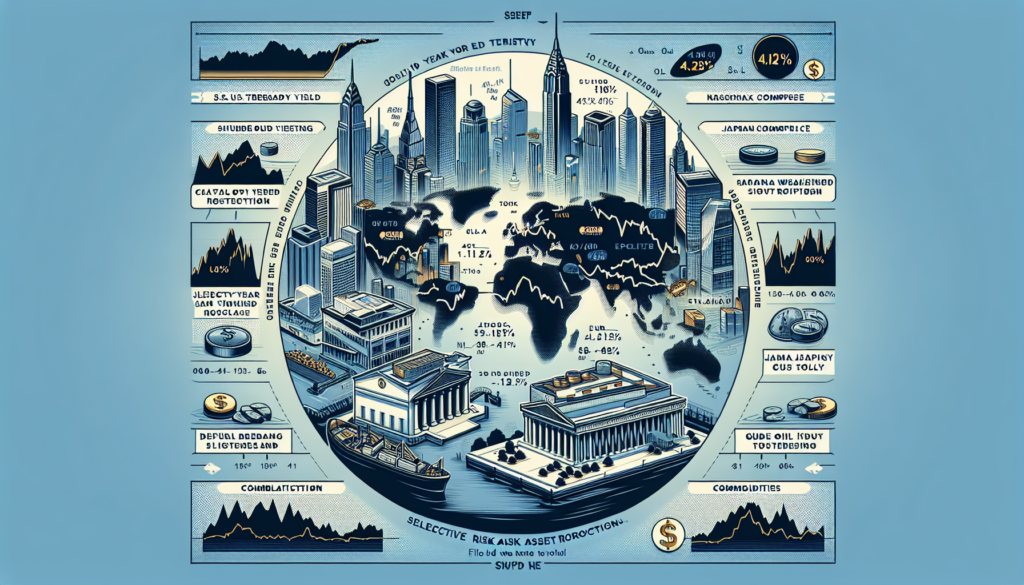
Global markets today painted a cautiously optimistic picture amid a complex mix of macroeconomic signals and policy developments. One of the most significant drivers this week was the U.S. Federal Reserve’s continued dovish tone, which appears to have resonated well with equity markets. Fed Chair Jerome Powell reiterated that while inflation has shown signs of cooling, the path towards sustained 2% inflation is still “bumpy,” which in effect delays rate cuts into 2025. However, Powell also emphasized that the Fed is no longer in a tightening stance, giving equity investors some degree of clarity. The S&P 500 responded positively, advancing nearly 0.7% in today’s session, led by gains in mega-cap tech stocks such as Apple, Microsoft, and Nvidia. The Nasdaq Composite once again outperformed, signaling market confidence in the technology sector. Perhaps the most telling movement came from the bond market — the 10-year U.S. Treasury yield has now dipped to around 4.12%, further confirming that traders anticipate a slow but steady normalization of monetary policy over the next few quarters. Europe, in contrast, faced more subdued momentum. Eurozone inflation data released earlier this morning showed a slight uptick in energy prices, raising concerns that the ECB might also delay its initial rate cuts. Germany’s DAX index was flat, while France’s CAC 40 edged down by 0.3%. The euro weakened slightly against the dollar, extending its weekly loss to 0.8%. Personally, this divergence in central bank policy stance — the Fed projecting a longer wait while the ECB remains more cautious — might contribute to a stronger dollar in the coming weeks, especially against the euro and yen. From an Asian market perspective, Chinese equities remained under pressure. The Shanghai Composite fell 0.6% amid continued investor skepticism about the effectiveness of Beijing’s stimulus measures. The property sector remains a persistent drag, with Evergrande’s liquidation hearing creating new uncertainty. Foreign outflows from China-listed equities have continued for a sixth straight session, in my view reflecting deeper concerns about long-term corporate governance and geopolitical tensions with Western economies. On the flip side, Japanese markets showed remarkable resilience, with the Nikkei 225 gaining over 1.2%, helped by upbeat manufacturing data and yen weakness, which continues to favor exporters. Commodities also offered insightful signals. WTI crude oil traded lower at $70.85 per barrel, reflecting both weak Chinese demand and rising U.S. inventory levels. Gold held firm near $1995/oz, a sign that investors are still hedging against potential economic volatility even amid the equity rally. In recent days, the commodity trend has been more indicative of risk-hedging behaviors rather than outright fear — something I take as a nuanced signal of cautious confidence rather than bullish exuberance. All in all, the market’s tone today suggests that investors are selectively rotating into risk assets while maintaining a defensive posture. I’m particularly watching the divergence between growth-led sectors in the U.S. and cyclical underperformance in Europe and Asia — a theme that could become more prominent as we enter the Q1 2026 earnings cycle and gain additional clarity on global policy normalization.

News

Markets React to Cool PPI and Fed Caution

Today’s market movements, as observed on Investing.com, reflect an interesting blend of caution and optimism across various asset classes, shaped largely by macroeconomic data out of the U.S., continued geopolitical uncertainties, and central bank policy expectations. From my perspective, there seems to be a recurring pattern lately where investors are caught between softer inflation prints and the Fed’s commitment to a higher-for-longer interest rate regime. The most notable catalyst in today’s session was the release of the U.S. Producer Price Index (PPI), which came in slightly cooler than expected. Monthly PPI rose by 0.1% compared to the consensus estimate of 0.2%, while the core figure followed a similar trend. This follows last week’s Consumer Price Index (CPI) reading, which also showed some tentative signs of disinflation. In response, the U.S. 10-year Treasury yield dipped below the 4.10% level, suggesting fixed-income investors are beginning to price in at least two rate cuts for 2026. However, Fed officials have remained consistent in pushing back against aggressive rate cut expectations, and today’s Fed speaker, Richmond Fed’s Barkin, reiterated that the central bank needs “more evidence” before making any policy pivots. Equity indices took this data with a cautiously optimistic tone. The S&P 500 edged higher, led by tech and consumer discretionary sectors. I noticed Apple and Microsoft saw renewed buying interest after consolidative moves last week. Notably, semiconductors also rallied, with the Philadelphia Semiconductor Index (SOX) up by over 1.5%, likely a result of lower bond yields making future growth prospects relatively more attractive. However, breadth remains an issue, as gains continue to be concentrated among mega-cap names, which raises concerns about the sustainability of this rally without broader market participation. Commodities painted a more complex picture. Crude oil prices dropped over 2% intraday after the International Energy Agency (IEA) revised its 2026 global oil demand forecast lower. Meanwhile, gold prices traded higher, approaching the $2,040/oz level, as softer inflation data and falling yields increased safe-haven demand. From my standpoint, the gold rally seems less about inflation hedging and more about anticipation of a Fed pivot, alongside geopolitical positioning, particularly with persistent tensions in the Red Sea and Middle East. Currency markets responded in line with broader macro expectations. The dollar index (DXY) retreated, moving closer to 103.5, largely driven by euro strength following better-than-expected German ZEW economic sentiment data. On the yen front, USD/JPY edged lower as well, hinting that Japanese officials could be preparing for more direct intervention, especially with the Bank of Japan expected to discuss potential exit strategies from its ultra-loose stance in an upcoming meeting. Overall, today’s market tone reflects a tug-of-war between the economic reality of slowing inflation and a Federal Reserve that remains committed to caution. Investors appear willing to position for a dovish pivot, but only incrementally. For now, risk sentiment remains intact, but I believe it is being supported more by liquidity hopes and yield dynamics rather than strong fundamental growth signals. Volatility may increase ahead of year-end positioning and as more clarity emerges on the timing of the Fed’s next move.

News

Market Outlook Shifts as Fed Rate Expectations Recalibrate

After closely monitoring today’s market developments on Investing.com, several key narratives are shaping the macro environment, particularly the U.S. Federal Reserve’s policy outlook, continued geopolitical tension in the Middle East, and a somewhat mixed bag of corporate earnings from tech and consumer sectors. From my perspective, we’re beginning to witness early signs of a broader risk-off sentiment as investors grapple with central bank uncertainties and economic resilience—especially in the U.S. and China. The most notable feature in today’s market action was the recalibration of rate cut expectations. Following the Fed officials’ statements and the latest CPI print from last week, any aggressive bet on a March 2026 rate cut appears to be fading. Futures pricing on Fed Funds now suggest only a 60% probability of a May cut, compared to over 80% just two weeks ago. Treasury yields have edged slightly higher today, with the U.S. 10-year pushing back above 4.25%, indicating that the market is preparing for a more prolonged period of elevated rates. U.S. equities opened the week with subdued strength but lost momentum toward midday trading. The S&P 500 is testing overhead resistance near the 4,715 level, and from the price action observed today, there seems to be hesitance in pushing toward fresh all-time highs. It’s clear that institutional investors are seeking more economic clarity before placing big bets ahead of the final two Fed meetings. What’s also interesting is the relative underperformance of the Nasdaq 100, as semiconductors dragged, partially due to reports that Apple’s Chinese iPhone demand is weakening, hinting toward broader concerns over consumer technology cycles. Geopolitically, the rising tension in the Red Sea as the Houthi rebel attacks on shipping routes continue to disrupt global logistics has spooked oil traders. Brent crude rose by over 1.8% during the session, crossing back above $76/barrel. As someone who tracks energy markets closely, I think this development could potentially put upward pressure on global inflation if the situation escalates. The energy sector reflected this momentum today, with several oil majors outperforming, notably ExxonMobil and Chevron, whose share prices gained between 1.5% and 2% intraday. On the foreign exchange front, the U.S. dollar gained strength against most major peers, with the DXY moving back above 104.3. This was driven by both safe-haven demand and changing interest rate differentials. The euro dipped below 1.08 again, and USD/JPY hovered near the crucial 146 level. As a trader, I am closely watching these FX pivot points, especially considering next week’s BOJ meeting, which could bring increased yen volatility. To sum it up, today’s market reflects a sense of cautious positioning. There’s a notable divergence between equity valuations and policy signals, particularly with the Fed staying data-dependent and inflation metrics proving sticky. The risk-reward dynamics are currently skewed to the downside unless there’s more definitive confirmation that inflation is sustainably declining or corporate earnings beat expectations broadly. Until then, I remain on the defensive side of market exposure, especially in high-beta sectors and speculative growth.

News

Market Shifts Amid Inflation and Rate Cut Hopes

Today’s financial markets are experiencing a blend of cautious optimism and underlying uncertainty, as investors digest the latest macroeconomic data, central bank communications, and geopolitical developments. From my perspective, the most significant driver today is the fresh inflation data coming out of both the U.S. and the Eurozone. In the U.S., the latest Consumer Price Index (CPI) numbers released earlier today came in slightly softer than expected—headline inflation rose 0.2% month-on-month versus the forecasted 0.3%. The core CPI, which strips out volatile food and energy prices, also showed a modest deceleration. This has reinforced investor sentiment that the Federal Reserve is likely done with its tightening cycle, reinforcing the narrative of rate cuts possibly beginning as early as Q2 2026. Market expectations, reflected in the CME FedWatch Tool, have now fully priced in a 25bps cut by the May 2026 FOMC meeting, and there’s an increasing probability of a March cut as well. This dovish tilt is pushing U.S. Treasury yields lower across the curve—most notably, the 10-year yield has dropped below 4% for the first time in three months. Equities responded in kind, with the S&P 500 registering modest gains, led by interest rate-sensitive sectors such as real estate and technology. On the other side of the Atlantic, the ECB also made headlines today with a notable shift in tone. While policymakers stopped short of promising immediate rate cuts, the central bank acknowledged in its official statement that “disinflation dynamics are gaining traction across the euro area.” This was further exemplified by Germany’s wholesale prices, which declined year-over-year by 1.2%, adding further evidence that the peak of inflation is firmly behind us. European equity indices, including the DAX and STOXX 600, extended their rallies, and the euro weakened slightly against the dollar, reflecting expectations of easier monetary policy in 2026. What’s particularly striking today is the strength in the technology sector, both in the U.S. and Europe. NVIDIA shares climbed nearly 4% following news that the company is ramping up production of its next-gen AI chips, which analysts expect to fuel another wave of enterprise adoption. Meanwhile, Microsoft hit another all-time high, driven by bullish sentiment following its recent announcement of integrating Copilot AI features deeper into its Office suite. The AI narrative continues to dominate investor psychology, and today’s price action confirms that institutional appetite for growth tech remains robust. Commodities are also reflecting a more risk-on mood. Crude oil prices climbed over 1.8% today, as the International Energy Agency (IEA) revised its 2026 demand forecast upward due to stronger-than-anticipated economic activity in Asia. At the same time, gold prices have slightly declined, as softer inflation took some urgency out of the safe-haven trade, and risk appetite increased among market participants. One area that demands attention is China. Despite today’s global rally, Chinese equities have underperformed once again, dragged by worrying signs of continued deflation and subdued domestic consumption. The Hang Seng Index closed down 0.6%, with large-cap property developers taking the brunt of the losses. As someone closely watching China’s strategic role in the global economic recovery, I’m increasingly concerned that without a strong fiscal policy response, the lingering deflationary pressures may spill over and complicate the global demand picture in 2026. Overall, markets appear to be transitioning from a rate-hiking environment to one preparing for policy easing. Yet, the path forward is likely to remain uneven, especially with ongoing risks tied to geopolitics, U.S. election uncertainty, and China’s economic frailty.

News

US Markets Rally as Fed Pivot Hopes Strengthen

After reviewing today’s latest financial data from Investing.com, several clear trends have emerged that, in my view, are reshaping short-term market sentiment heading into the final trading weeks of 2025. The most striking development has been the continuous strength of the U.S. equities market, with the S&P 500 pushing to another record high early in Monday’s session. Investor enthusiasm remains buoyant thanks to last week’s lower-than-expected PPI and CPI prints, reinforcing expectations that the Federal Reserve could begin cutting rates sooner than previously projected — possibly as early as Q2 2026. The Fed’s final meeting of the year, set for Wednesday, is now priced in by the market to leave rates unchanged, but dot-plot revisions and Powell’s post-decision commentary are likely to be the focal point. What reinforces the bullish bias, in my opinion, is how resilient consumer sentiment is proving to be. The University of Michigan’s preliminary December reading came in sharply above consensus, with inflation expectations moving significantly lower. This dual confirmation — moderating inflation and steady consumption — supports the idea that the U.S. economy could be gliding toward a soft landing, a scenario that just a few months ago seemed overly optimistic. Tech stocks are leading the rally, driven by AI momentum and stabilization in the semiconductor sector, with Nvidia and AMD continuing to see strong inflows. Apple’s rebound, fueled by its emerging push into generative AI integration in iOS, also appears to be regaining market confidence after a relatively muted Q3. An interesting aspect to watch is the resurgence in mid-cap and small-cap names, which have largely underperformed for the year. The recent rotation suggests that investors are broadening their exposure, perhaps betting on a more cyclical upswing in 2026. The U.S. dollar, meanwhile, has come under pressure, with the DXY index retreating significantly over the past 48 hours. This is directly tied to the shift in Fed expectations, putting upward pressure on both gold and emerging market assets. Gold broke above $2,030 again, and although it remains volatile, I think the combination of a weaker dollar and growing central bank buying (especially from China and India) gives it a supportive floor into the early part of 2026. Crude oil markets also showed signs of life after weeks of decline. Brent crude bounced above $76/barrel amid renewed geopolitical tensions in the Red Sea and speculation that OPEC+ may revisit production cuts at the start of 2026. However, from a macro lens, the overriding theme remains one of balanced supply and softening global demand — particularly with weak industrial output data from Europe and China weighing on the longer-term trajectory. Bond markets are signaling strong demand, especially at the long end, with the 10-year yield now near 4.15%, a full 75 basis points lower than the October peak. This reinforces a Goldilocks narrative — inflation is falling, growth is not collapsing, and the Fed may pivot dovish. If this proves accurate, risk assets could remain well supported into January. From a positioning standpoint, I notice that investor sentiment is increasingly aligning with a “Fed pivot” risk-on scenario, but risks remain. Commercial real estate concerns, possible earnings downgrades in Q1, and the potential for inflation to remain sticky should not be dismissed. Overall, the tone in the financial markets has clearly shifted more positively over the past two weeks, but whether this rally has legs depends heavily on this Wednesday’s FOMC outcome and the Fed’s guidance into 2026.

News

Global Markets Shift as Inflation and Fed Outlook Evolve

Today’s market action underscores the sharp crosscurrents influencing global investor sentiment, driven by a tapestry of economic data, central bank positioning, and geopolitical developments. From my perspective, the equity and bond markets are at a crucial inflection point as we close out 2025, with increasing signs that liquidity, inflation expectations, and softening economic momentum are beginning to realign investor behavior in a meaningful way. The U.S. equity markets opened mixed this morning, largely absorbing the latest CPI report which came in slightly softer than expected. Annualized core inflation dropped to 3.6%, down from the prior 3.8%, adding credence to the view that the Federal Reserve’s tightening cycle may have reached its peak. This has injected a degree of cautious optimism among traders as the probability for a rate cut in Q1 2026 rises. Treasuries responded immediately — the 10-year yield fell below the 4.1% mark for the first time since July, deepening the yield curve inversion yet again. Investors are increasingly pricing in not just a “pause,” but potentially two rate cuts by mid-2026. What intrigues me is the decoupling behavior emerging between sectors. While tech remains buoyant, driven by artificial intelligence enthusiasm and robust Q4 forecasts from companies like Nvidia and Microsoft, traditional cyclical sectors such as industrials and energy are lagging. Crude oil prices dropped below the $71 handle after today’s IEA report trimmed global oil demand forecasts for the first half of 2026, citing persistent consumer weakness in China and Europe. Brent futures slipped more than 1.5%, adding pressure on energy majors and stoking concerns of a broader commodities downcycle. Speaking of China, the signals out of Beijing are equally crucial. The PBoC kept key lending rates unchanged, but injected additional mid-term liquidity into the financial system via a higher-than-expected MLF operation — a clear signal that domestic conditions remain fragile. Markets have reacted tepidly, with the Hang Seng closing down 0.6%, despite minor gains in Alibaba and JD.com after government regulators hinted at loosening cross-border data flow rules. From my viewpoint, unless we see a more aggressive real estate rescue package or broader fiscal intervention, the Chinese recovery path remains an uphill battle. European markets mirrored the cautious tone. The ECB’s latest remarks suggest increasing divisions within the Governing Council, as inflation numbers across the Eurozone cool faster than anticipated. The euro fell to a three-month low versus the dollar, now hovering below 1.07, reinforcing the broader strength of the greenback. However, the dollar index itself is showing fatigue, and I believe a softer inflation trend in the U.S. coupled with dovish Fed guidance could begin to reverse this trend early next year. Cryptocurrencies were a standout today. Bitcoin surged above $45,000 after the SEC signaled openness to reconsider several pending spot ETF applications. This marks a critical psychological level and reaffirms the broader narrative of digital asset legitimacy. However, I remain cautious since this rally is heavily news-driven and lacks confirmation from broader on-chain activity growth. In conclusion, markets appear to be in transition: from a rate hike era to a potentially easing regime. While this provides short-term tailwinds for risk assets, I am closely watching real economic indicators, particularly labor market softness and consumer credit trends, for signs of a more sustained pivot. The coming weeks could prove pivotal in defining the first half of 2026.

News

Market Outlook: Fed Signals, Oil Surge, Bitcoin Resilience

As I review today’s financial market developments on Investing.com, it’s becoming increasingly clear that we are entering a phase of cautious optimism, albeit tempered by macroeconomic uncertainties and central bank signaling. The broader equity markets, including the S&P 500 and NASDAQ, posted modest gains, supported primarily by strong performances within the technology and consumer discretionary sectors. This rally is reflective not only of earnings resilience but also of a general sense that the worst of the tightening cycle might be behind us. However, several key themes merit deeper analysis. First, the persistent narrative dominating investor sentiment today is the increasingly dovish tone from the Federal Reserve. Chair Jerome Powell’s recent remarks hinted at a potential rate cut in the first half of 2026, provided inflation continues to cool. This has been reinforced by today’s softer-than-expected Producer Price Index (PPI) report, showing a month-over-month increase of just 0.1%, well below the consensus estimate of 0.3%. The data suggests that supply chain pressures and input cost inflation are abating, which could give the Fed more room to pivot without triggering inflationary feedback. Yet, despite this positive signal, the bond market continues to send mixed messages. Yields on the 10-year Treasury fell slightly to 4.14%, indicating a view that economic growth may slow further heading into Q1 2026. This yield drop also underscores concerns among fixed-income investors about weakening labor demand, as evidenced by last week’s surprisingly high jobless claims. While equity investors interpret potential cuts as bullish for stocks, bond markets tell a story of caution, perhaps even latent recessionary fears. In the commodities space, crude oil prices surged more than 2% today, supported by renewed geopolitical tensions in the Middle East and falling inventory levels reported by the EIA. West Texas Intermediate (WTI) traded around $74.50 per barrel, and the oil rally contributed to a bounce in energy sector stocks. However, this upward momentum might be short-lived. If global demand weakens further — particularly from China, whose economic indicators remain tepid despite recent People’s Bank of China policy easing — then oil’s rally could lose steam quickly. Speaking of China, the Hang Seng Index closed lower again today, dragged down by tech giants and lingering fears over the country’s property sector instability. With Evergrande’s liquidation still pending, and youth unemployment hovering near all-time highs, Beijing’s ability to stimulate sustainable domestic demand remains in question. As an investor, I’m becoming increasingly skeptical about overweighting Asia-Pacific exposures in 2026 allocations despite their relatively attractive valuations. Cryptocurrency markets also caught attention with Bitcoin trading above the $41,000 level, a notable resilience considering dollar strength and rising regulatory scrutiny. Institutional adoption continues to gain ground, especially after BlackRock’s spot Bitcoin ETF proposal gained SEC traction. While the digital asset space remains volatile, there is a growing sense that crypto is transitioning from speculation to a more structured asset class, particularly as governments globally discuss frameworks for transparency and taxation. All told, the landscape is complex. While equity markets may continue their grinding upward trajectory, especially if inflation data remains cooperative, a cautious stance is still warranted. Investors seem poised on a narrow edge: positioned to capture upside from monetary easing, but ever-aware of the potential for growth disappointment just around the corner.

News

Market Signals Shift Amid Inflation and Fed Uncertainty

Today’s market movements have provided some compelling signals that investors need to pay close attention to, especially as we approach the end of the year and volatility is creeping back into equities, commodities, and currency markets. Based on the latest data and news flow from Investing.com this morning, several key developments are shaping my near-term outlook across asset classes. First and foremost, equity markets are showing signs of hesitation after a relatively strong November and early December rally. U.S. indices like the S&P 500 and NASDAQ opened lower today following mixed inflation data and an increasingly cautious tone among Fed officials. The November PPI numbers, which came in slightly hotter than expected, have revived some concerns about how sticky inflation might remain going into Q1 of 2026. This comes after several days of optimism that the Fed might pivot towards rate cuts as early as March. However, today’s data complicates that narrative — and the futures market has already started to reprice the probabilities, with rate cut bets now pushed slightly further out. At the same time, treasury yields are rising again, signaling that bond traders are starting to question the depth and timing of any 2026 monetary easing. The 10-year yield has moved back above 4.30%, and this could create renewed pressure on technology stocks, which had benefited the most from falling yields in the previous weeks. From where I stand, this may introduce rotational flows out of high-growth sectors and back into defensive plays like utilities and consumer staples. On the commodity side, crude oil is under notable pressure today, with WTI futures sliding below $71 per barrel despite ongoing geopolitical risks in the Middle East. This suggests that market participants are more focused on the demand side, particularly the weaker-than-expected industrial activity data coming out of China this morning. The Chinese economy continues to struggle with deflationary pressures and sluggish domestic consumption, and this is weighing on global demand expectations for crude and other industrial commodities. In my view, if China fails to announce a comprehensive fiscal package soon, we may see another leg lower for commodities tied to industrial production. Looking at the currency markets, the U.S. dollar is finding support again after a week of steady weakening. Today’s PPI surprise provided a floor for the dollar, particularly against the euro and Japanese yen. The EUR/USD pair dropped back to the 1.08 handle, and USD/JPY climbed above 146. This reflects not only the shifting Fed rate cut expectations but also the comparatively dovish stance maintained by the ECB and BOJ. For now, the dollar may regain momentum as global central banks diverge in their policy outlooks. I’m watching especially how the BOJ will act in its upcoming meeting, amid speculation that yield curve control might be adjusted or even abandoned — a move that could cause significant volatility in JPY crosses. Overall market sentiment today feels cautious, slightly risk-off, and increasingly data-dependent. We’re entering a phase where investors are re-evaluating the “soft landing” scenario that many had priced in, especially in the U.S. Whether markets recover some traction after the Fed’s final meeting of the year will depend heavily on forward guidance and any changes to the dot plot. Until then, I expect choppy trading conditions, and a premium will be placed on active risk management.

News

Global Markets React to Inflation and Rate Shift Risks

This week has revealed a striking level of volatility across global financial markets, largely driven by renewed concerns about inflation trajectories, central bank policy recalibrations, and geopolitical tensions intensifying in key regions. As of today, markets are reacting noticeably to the latest U.S. inflation data released earlier this morning. November’s Consumer Price Index (CPI) came in slightly higher than expectations — headline inflation rose 0.4% month-over-month, versus the expected 0.3%, while core inflation stayed persistently high at 0.3%. This reinforces my concern that the disinflation narrative priced into equities recently may have been somewhat premature. The immediate reaction in the bond market was telling. U.S. Treasury yields spiked, with the 10-year yield climbing back to 4.35% after dipping below 4.2% earlier in the week. This suggests that investors are now reevaluating the probability of rate cuts by the Federal Reserve in Q1 2026. Just days ago, futures markets had priced in a nearly 70% probability of at least two rate cuts by May. As of this afternoon, that number has dropped significantly to under 50%, and I expect it to hover around that level until the December FOMC minutes are released. Equity markets have responded with hesitation. The S&P 500 opened flat and quickly turned negative, with the tech-heavy Nasdaq dropping over 1% before stabilizing mid-session. High-growth tech stocks, which have been leading the late-year rally, are particularly sensitive to rising yields. Apple and Nvidia both traded down more than 2% during the first half of today’s session. From my point of view, this suggests institutional investors are rotating away from duration-sensitive assets, back into value and defensive names. European markets also reflect a cautious tone. The DAX and the CAC 40 are mildly red, as ECB President Christine Lagarde reiterated this morning that it was still “too early” to discuss rate cuts despite better-than-expected economic sentiment in Germany. This reinforces the narrative that central banks, while open to loosening policy in 2026, remain deeply data-dependent — a theme that, in my view, will define the first quarter of next year. On the commodities side, oil prices have been surprisingly resilient. Brent crude is holding above the $76 level, supported by ongoing supply concerns due to escalating tensions in the Red Sea region. Over the weekend, commercial shipping activity through the Suez Canal dropped significantly due to Houthi rebel activity, according to satellite and logistics data. This geopolitical flashpoint could act as an underappreciated tail risk for inflation, especially if it results in sustained supply chain disruptions into Q1. I’m closely monitoring this dynamic, because energy cost pressures could complicate central bank easing plans. In FX markets, the U.S. dollar has staged a modest rebound, particularly against the Japanese yen and the euro. The greenback’s strength today could largely be attributed to the upward surprise in CPI data, reinforcing the dollar’s safe-haven appeal in a data-sensitive environment. USD/JPY pushed above 145.30 again, retracing some of its losses from last week when speculation of a BOJ policy shift was elevated. It’s clear that any BOJ hawkish surprises are being tempered by global yield repricing. Crypto markets, in contrast, remain in a speculative uptrend. Bitcoin crossed above $42,000 again, as institutional interest ahead of the January ETF decision continues to pick up. Volumes remain strong on CME Bitcoin futures, and the options market is showing increased open interest in long-dated calls. While I continue to see significant upside potential here, the asset class remains exposed to regulatory developments in early 2026. In sum, today’s financial landscape is defined by recalibrations and repricings. The market is no longer in a straightforward “rate cuts coming” environment — it’s entering a phase of nuanced interpretation, asymmetric risks, and a strong sensitivity to every economic and geopolitical headline.

Scroll to Top