
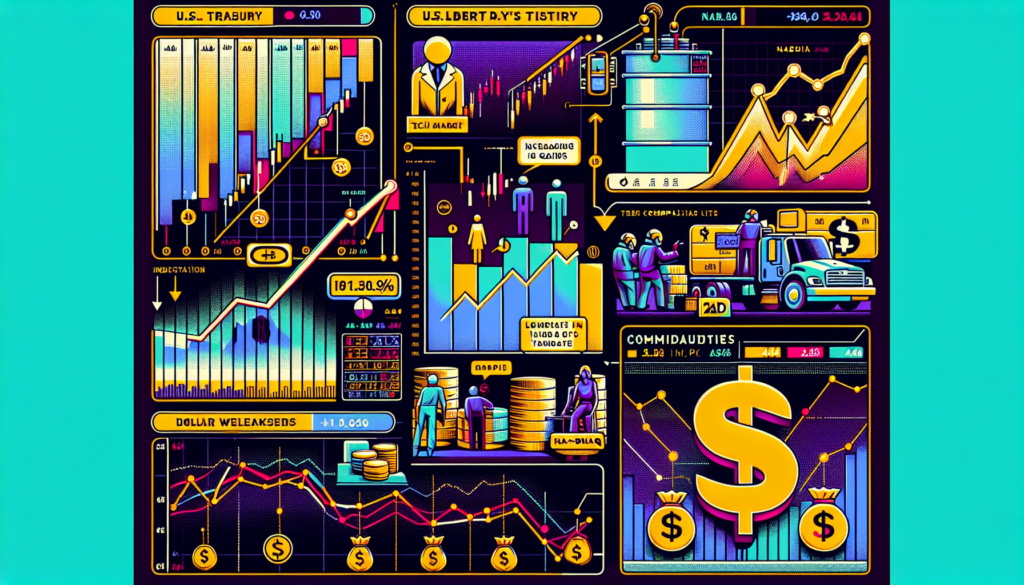
After closely monitoring the financial markets today on Investing.com, I observed several key macroeconomic indicators and market movements that reflect a complex but interesting landscape as we head deeper into Q1 2026. One of the most pronounced developments was the continued weakness in U.S. Treasury yields, signaling that investor sentiment remains cautious despite a significant improvement in economic indicators such as the U.S. non-farm payrolls report released last Friday.
The labor market continues to display resilience, with December jobs surpassing expectations at 248,000 versus the 170,000 projected. Normally, such strong labor data might ignite fears of renewed hawkishness from the Fed. However, today’s bond market action suggests the opposite — yields on the 10-year note fell back below 3.85%, signaling investors are still pricing in a higher probability of the first Fed rate cut coming as early as March. To me, this divergence highlights a critical tug-of-war between the Fed’s forward guidance and market expectations, where optimism on inflation is overriding short-term data strength.
In equities, the tech-heavy Nasdaq led gains, finishing the session up over 1.3%, powered by big names like Nvidia and Apple reclaiming key moving averages. The AI enthusiasm shows no signs of slowing, and chipmakers continue to benefit from both investor momentum and real fundamentals, as today’s report showed YoY semiconductor sales rising for the first time in seven months. As someone analyzing these trends daily, I see this as a confirmation of the sector rotation narrative that began late last year — away from defensives and towards high-beta growth, particularly in tech and communications.
On the commodities side, oil prices edged higher amid tensions in the Middle East, specifically with ongoing concerns about Red Sea shipping disruptions. Brent crude is back above $79 and WTI closed well above the $74 per barrel mark. This geopolitical premium, combined with signs of tightening inventories from the latest EIA data, suggests a short-term bullish trend. However, I remain cautious. Without a sustained increase in global demand, these gains may lose momentum shortly. Chinese economic data continues to lack the velocity markets had hoped for, with today’s Caixin Services PMI slightly missing expectations at 51.2, again hinting at uneven recovery fronts.
Gold prices, meanwhile, continue to hover near the $2,050 level, a strong consolidation range that indicates investors are still hedging against both inflation and geopolitical risk. Despite stronger job numbers, gold’s resilience today reaffirms its appeal in the current macro backdrop where uncertainty remains elevated.
Finally, in the FX markets, the U.S. dollar weakened slightly against major peers. The DXY index slipped to 102.1, driven largely by euro and yen strength. The ECB minutes released today revealed policymakers are becoming more confident that inflation is on a steady downward trajectory, potentially opening the door for rate cuts in late Q2. This dovish tilt, ironically, did little to strengthen the euro further, indicating that traders had already priced in a more accommodative tone. As a result, what stood out to me is that the FX markets might be entering a consolidation phase, awaiting clearer signals on federal and ECB policy divergence.
Today’s session, overall, reinforces my view that while macroeconomic data shows pockets of strength, the markets are trading heavily on expectations — expectations of easing central banks, lower inflation, and strong corporate earnings in tech and energy. The sustainability of these trends will be tested as earnings season ramps up this month.