
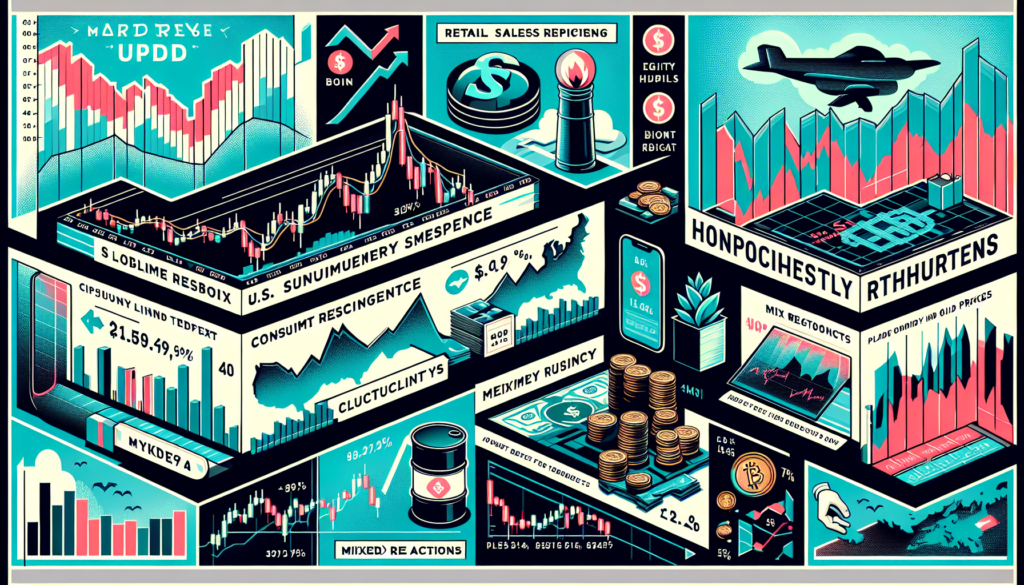
In today’s market session on Investing.com, I observed several critical developments that, in my view, are likely to shape investor sentiment in the near term. The most notable move was the continued strength of the U.S. dollar index (DXY), which climbed above 103.5, reflecting renewed investor confidence following recent hawkish commentary from multiple Federal Reserve officials. This comes in spite of earlier expectations of a March rate cut, which are now being repriced amid stronger-than-expected economic data.
The latest retail sales data from the U.S. showed a 0.6% month-over-month increase in December, almost double the market’s forecast of 0.3%. This surge in consumer spending, especially around the holiday season, suggests that the American consumer remains resilient and that inflationary pressures could remain sticky in certain sectors. As a result, the bond market reacted sharply — the 10-year Treasury yield moved above 4.1%, reflecting adjusted rate hike expectations or at least a longer period of restrictive monetary policy.
Equity markets showed some divergence. The Dow Jones Industrial Average held close to all-time highs, driven primarily by strong earnings reports from major financial institutions like JPMorgan and Goldman Sachs. These companies have managed to outperform in a high-rate environment, benefiting from net interest margin expansion and resilient capital markets. In contrast, the Nasdaq slipped slightly, dragged down by a rotation out of tech as higher yields weighed on valuations. I noticed a clear cooling-off in highly speculative AI and semiconductor stocks, which had been running hot over the past few weeks.
On the commodities side, oil prices rebounded, with WTI crude rising above $74 a barrel. In my assessment, this is largely due to geopolitical tensions in the Middle East — specifically in the Red Sea — where continued attacks on shipping routes have raised concerns about potential supply disruptions. Additionally, the International Energy Agency (IEA) revised its global demand outlook upward for 2024, further supporting bullish sentiment in the energy markets.
On the international front, China’s GDP growth for Q4 came in at 5.2% year-over-year, just slightly above the government’s target. Yet, the underlying economic data suggests ongoing softness, especially in the property sector and exports. That’s why Chinese equities failed to rally despite the headline beat. I remain cautious about the Chinese economy given structural challenges and limited policy ammunition.
Looking at cryptocurrencies, Bitcoin briefly attempted to reclaim the $43,000 level today but faced resistance after some profit-taking set in following the ETF approvals earlier this month. Institutional inflows remain positive but slowed down this week, hinting at a near-term consolidation phase.
Taking all these elements together, I see a market still navigating conflicting narratives: optimism on earnings and economic resilience, counterbalanced by inflation concerns, a delayed Fed pivot, and geopolitical uncertainty. This fragmented picture suggests lower visibility for Q1 2026, with volatility likely to pick up in both equity and fixed-income markets.